PRKN Variant Annotation And Functional Assay Evidence
PRKN Variant Annotation Table, Continuation
Table headers:
Index
Databases
Parkin Variant
Annotation with clinical evidence
Functional group
Annotation with clinical and functional evidence
Continuation rows:
| index | databases | Parkin variant | clinical evidence annotation | functional group | clinical + functional annotation |
|---|---|---|---|---|---|
| 18 | Disease and population | p.Q34R | Benign | 3 | Benign |
| 19 | Disease and population | p.AS2E / p.A52E? | Benign | 4 | Benign |
| 20 | Disease and population | p.S167N | Benign | 4 | Benign |
| 21 | Disease and population | p.R334C | Benign | 5 | Benign |
| 22 | Disease and population | p.V380L | Benign | 4 | Benign |
| 23 | Disease and population | p.D394N | Benign | 4 | Benign |
| 24 | Disease and population | p.D18N | Uncertain significance | 4 | Likely benign |
| 25 | Disease and population | p.R33Q | Uncertain significance | 4 | Likely benign |
| 26 | Disease and population | p.P37L | Uncertain significance | 5 | Likely benign |
| 27 | Disease and population | p.R42C | Uncertain significance | 4 | Likely benign |
| 28 | Disease and population | p.R42H | Uncertain significance | 4 | Likely benign |
| 29 | Disease | p.W54R | Uncertain significance | 3 | Uncertain significance |
| 30 | Disease and population | p.R104W | Uncertain significance | 3 | Uncertain significance |
| 31 | Disease | p.K161N | Uncertain significance | 2 | Pathogenic |
| 32 | Disease | p.M192V | Uncertain significance | 4 | Uncertain significance |
| 33 | Population | p.V224A | Uncertain significance | 5 | Likely benign |
| 34 | Disease and population | p.R234Q | Uncertain significance | 5 | Likely benign |
| 35 | Disease and population | p.T240M | Uncertain significance | 2 | Pathogenic |
| 36 | Population | p.V248I | Uncertain significance | 4 | Likely benign |
| 37 | Disease | p.C253F | Uncertain significance | 1 | Pathogenic |
| 38 | Disease and population | p.R256C | Uncertain significance | 5 | Likely benign |
| 39 | Disease and population | p.D280N | Uncertain significance | 4 | Likely benign |
| 40 | Disease | p.C289G | Uncertain significance | 1 | Pathogenic |
| 41 | Disease and population | p.E310R | Uncertain significance | 4 | Likely benign |
| 42 | Disease | p.G328E | Uncertain significance | 4 | Uncertain significance |
| 43 | Disease and population | p.R334H | Uncertain significance | 4 | Uncertain significance |
| 44 | Disease | p.T351P | Uncertain significance | 4 | Uncertain significance |
| 45 | Disease and population | p.G359D | Uncertain significance | 3 | Uncertain significance |
| 46 | Disease and population | p.R366W | Uncertain significance | 4 | Likely benign |
| 47 | Disease and population | p.R396G | Uncertain significance | 4 | Uncertain significance |
| 48 | Disease | p.C418R | Uncertain significance | 1 | Pathogenic |
| 49 | Disease and population | p.P437L | Uncertain significance | 2 | Pathogenic |
| 50 | Disease and population | p.E444Q | Uncertain significance | 4 | Uncertain significance |
| 51 | Disease and population | p.M458L | Uncertain significance | 5 | Likely benign |
Figure 1: Parkin Missense Variants Functional Alterations
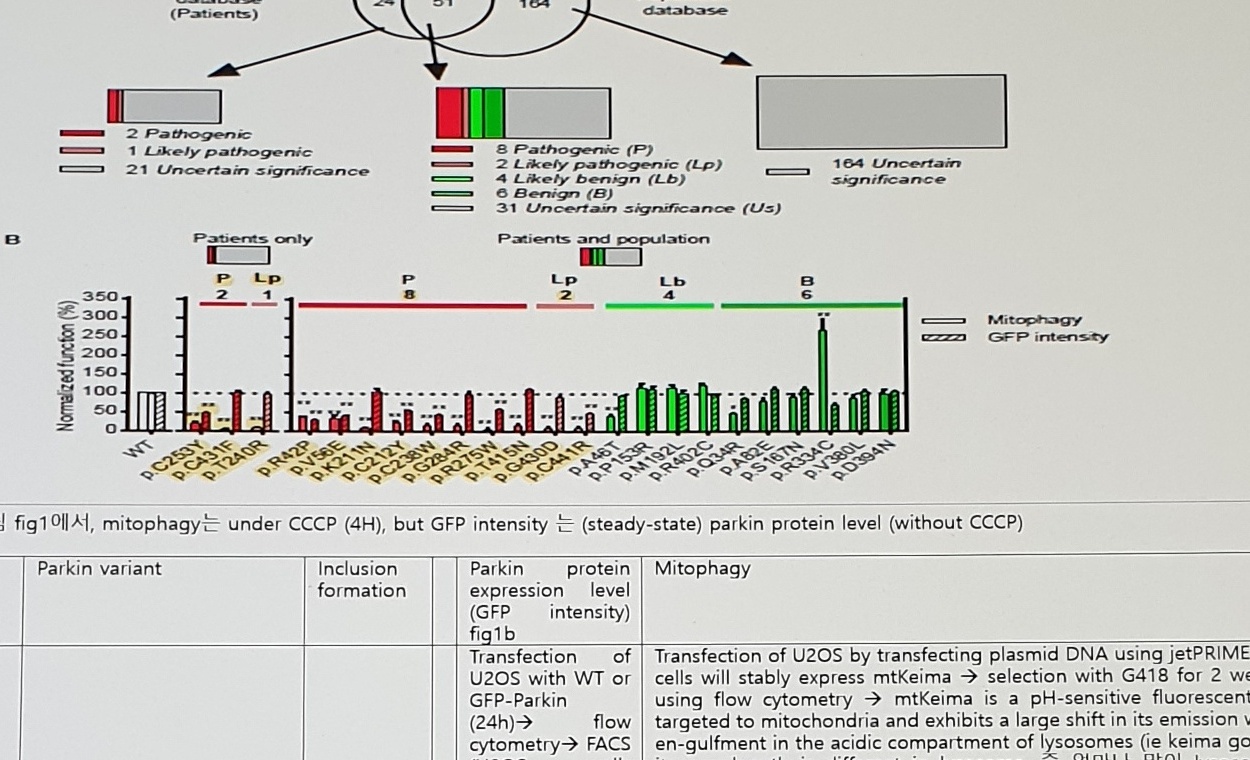
Caption and legend:
Figure 1. Parkin missense variants displayed a wide range of functional alterations.

A
Disease specific database (Patients)
24
51
164
Population database

2 Pathogenic
1 Likely pathogenic
21 Uncertain significance

8 Pathogenic (P)
2 Likely pathogenic (Lp)
4 Likely benign (Lb)
6 Benign (B)
31 Uncertain significance (Us)

164 Uncertain significance

B
Patients only
Patients and population
Normalized function (%)
Mitophagy
GFP intensity
Note below Figure 1:
위 그림 fig1에서, mitophagy는 under CCCP (4H),
but GFP intensity 는 (steady-state) parkin protein level (without CCCP)
Parkin Variant Functional Assay Table
Table headers:
| column | visible header |
|---|---|
| domain/category | leftmost column, partially clipped |
| variant | Parkin variant |
| inclusion | Inclusion formation |
| protein expression | Parkin protein expression level (GFP intensity) fig1b |
| mitophagy | Mitophagy |
| example | Example |
Method row:
| measurement | visible method text |
|---|---|
| Parkin protein expression level | Transfection of U2OS with WT or GFP-Parkin (24h) -> flow cytometry -> FACS (U2OS cells express very low levels of Parkin, 그러니 GFP signal 은 다 exogenous 임) |
| Mitophagy | Transfection of U2OS by transfecting plasmid DNA using jetPRIME (Polyplus) -> the cells will stably express mtKeima -> selection with G418 for 2 weeks and sorting using flow cytometry -> mtKeima is a pH-sensitive fluorescent protein that is targeted to mitochondria and exhibits a large shift in its emission wavelength upon en-gulfment in the acidic compartment of lysosomes (ie keima goes into mito and its wavelength is different in lysosome, 즉 얼마나 많이 lysosome 내로 갔는지 판단가능), in the presence of CCCP (20 uM, 4h) |
Variant rows:
| domain/category | Parkin variant | inclusion formation | protein expression | mitophagy | example / note |
|---|---|---|---|---|---|
| Ubl domain | p.R42P (ARG42PRO) | X | down arrow | down arrow | |
| Ubl domain | p.V56E | X | down arrow | down arrow | |
p.K211N | equals | down arrow | |||
| RORBR domain | p.C212Y | O | down arrow | down arrow | |
| RORBR domain | p.C238W (= p.Cystein238Tryptophan) | O | down arrow | down arrow | (Zanellati, 2015 #712) |
| RORBR domain | p.C253Y | O | down arrow | down arrow | |
p.G284R | equals | down arrow | |||
p.T415N | equals | down arrow | |||
p.C431F | equals | down arrow | |||
| RORBR domain | p.C441R | O | down arrow | down arrow | |
p.T240R | equals | down arrow | |||
| RORBR domain | p.R275W (= p.Arg275Tryptophan) = R>W, C.823>T, or rs34424986, VCV000007050 | O | down arrow | note present | FATHMM/COSMIC/Yi notes |
| clipped left note | R275Q: p.Arg275Gln; c.824G>A; Variation ID: 931482; Accession: VCV000931482.2; rs 번호는 없네 | circle marker | |||
p.G430D (= p.Gly430Asp) | equals | down arrow | (Mortiboys, 2008 #719) | ||
p.K161N | note present | ||||
p.C253F | note present |
Notes embedded in the functional-assay table:
p.R275W (= p.Arg275Tryptophan)
= R>W, C.823>T, or rs34424986,
VCV000007050 (이걸로 UNBBN에서 여럿 보이나 다 정상)

FATHMM prediction Pathogenic score: score 0.87
(이건 cancer 용인가?) is with
https://cancer.sanger.ac.uk/cosmic/mutation/overview?id=98884592

Yi 2019 의 suppl table 보면 (excel), benign point from MAF in population 이 1임,
이건 normal people 에서도 일부 발견된다는 말 아닌가?
그러나 Benign points from homozygotes in population 가 0인걸 보면,
적어도 homoz는 일반에서 안 발견되나 봄.

R275Q: p.Arg275Gln
c.824G>A Variation ID: 931482, Accession: VCV000931482.2,
rs 번호는 없네

Js: these two were not found as clinical pathogenic, but from functional assays
(mitophagy, protein expression), these two look pathogenic
ACMG-AMP Clinical Evidence Criteria Note
Text:
Note) [methods] 이 전체가 ACMG-AMP criteria

1. Clinical evidence (from public database) 먼저:
Pathogenic vs Benign (scoring system, algorithm-based) (2019 Yi)
Table:
| pathogenic | benign |
|---|---|
the more patients in the family homoz or compound heteroz in Parkin ('Segregation within family', the more pathogenic | Age > 50 |
suppl table 보면 (excel), 13개 pathogenic variants 는 모두 Benign points from homozygotes in population 가 0임. 즉 거꾸로 0인 것들만 모아서 pathogic 이라고 했다는 뜻. | The more common in population database (ExAC, Exosome variant serve, dbSNP), the more benign, (even if they are homoz!) |
Bottom clipped fragment:
... 해서 13 pathogenic & likely pathogenic variants 정리
2.
Uncertain Spans
| location | text/status | reason |
|---|---|---|
| statusbar/body overlap | 75?, Yi's study: 13, Yi's study: 10, 70% of all mutations | Some text is visible through the Word status/status overlap and should not be used as structured data without checking the image. |
| row 19 | p.AS2E / p.A52E? | Variant characters are visually ambiguous. |